Infrared light goes from 400 to 4000 , or
Zones of IR Spectroscopy
- The Polar ‘s
- The ‘s
- The Triple Bonds
- The Carbonyls
- The Double Bonds
| Bond | Stretching Frequency () | Intensity and Shape | Zone |
|---|---|---|---|
| Alcohol | 3650-3200 | Usually strong and broad | 1 |
| Alkyne | 3340-3250 | Usually strong and sharp | 1 |
| Amine or amide | 3500-3200 | Medium; often broad | 1 |
| Aryl or vinyl | 3100-3000 | Variable | 2 |
| Alkyl | 2960-2850 | Variable | 2 |
| Aldehyde | ~2900, ~2700 | Medium; two peaks | 2 |
| Carboxylic acid | 3000-2500 | Usually strong; very broad | 2 |
| Alkyne | 2260-2000 | Variable and sharp | 3 |
| Nitrile | 2260-2220 | Variable and sharp | 3 |
| Ketone | 1750-1705 | Strong | 4 |
| Ester | 1750-1735 | Strong | 4 |
| Aldehyde | 1740-1720 | Strong | 4 |
| Carboxylic acid | 1725-1700 | Strong | 4 |
| Amide | 1690-1650 | Strong | 4 |
| Alkene | 1680-1620 | Variable | 5 |
| Benzene | ~1600; ~1500-1450 | Variable; 1600 often two peaks | 5 |
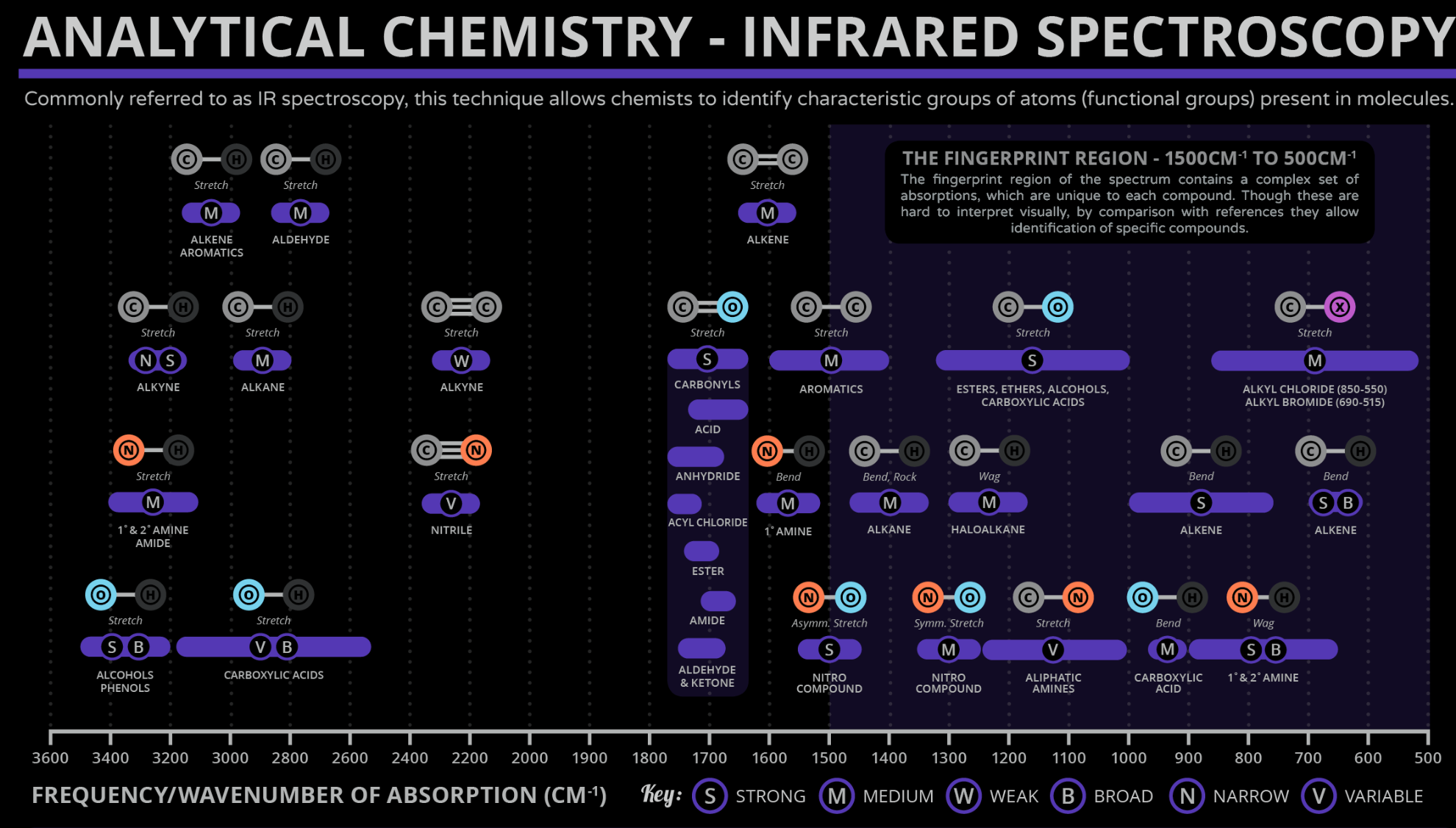
| Below 1400 is the fingerprint region, which mostly contains bending vibrations and unfortunately a lot of noise |
IR Spectroscopy Chart
- The stretching vibrational frequency of light
- is the speed of light
- is the spring constant
- is the reduced mass