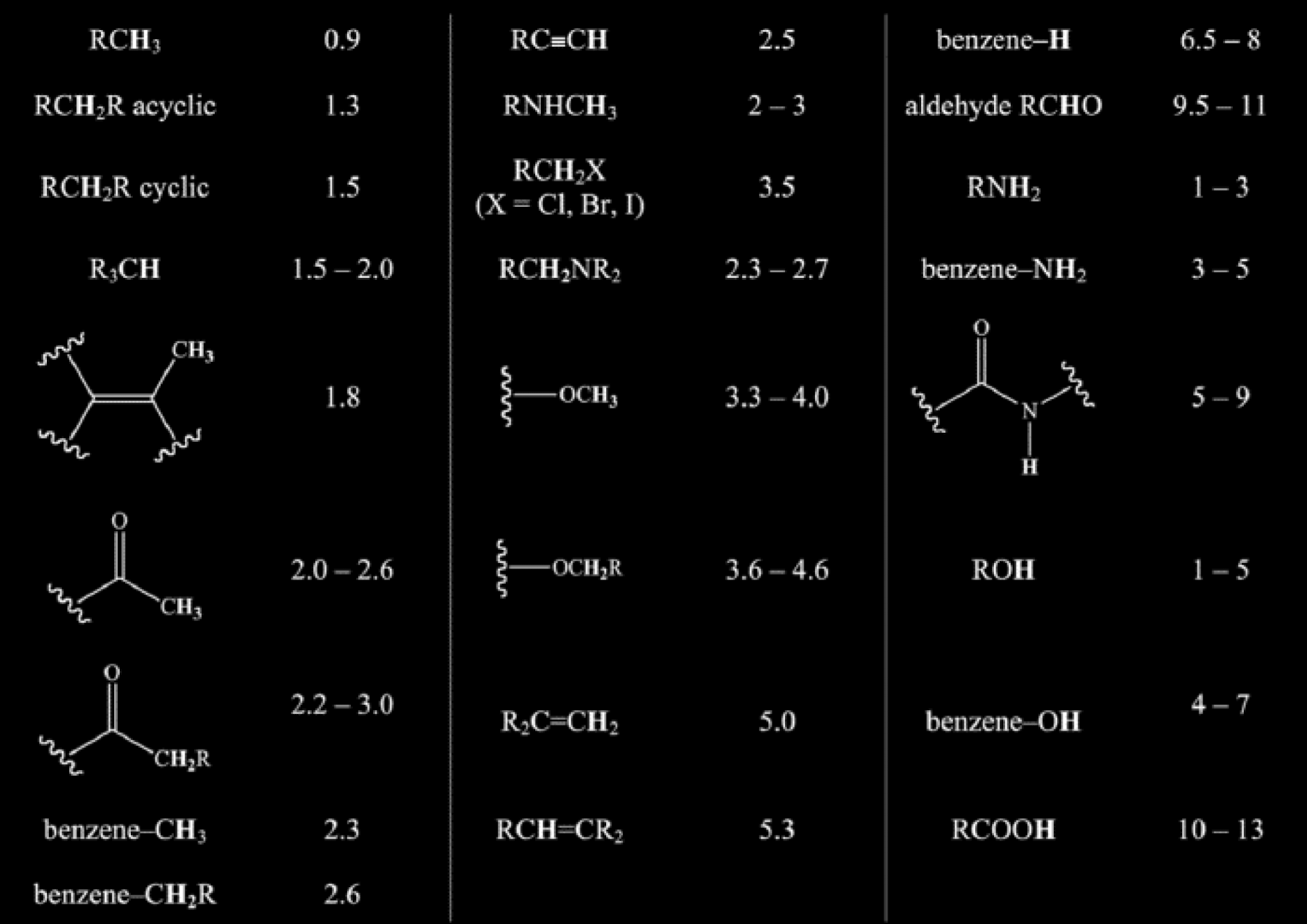
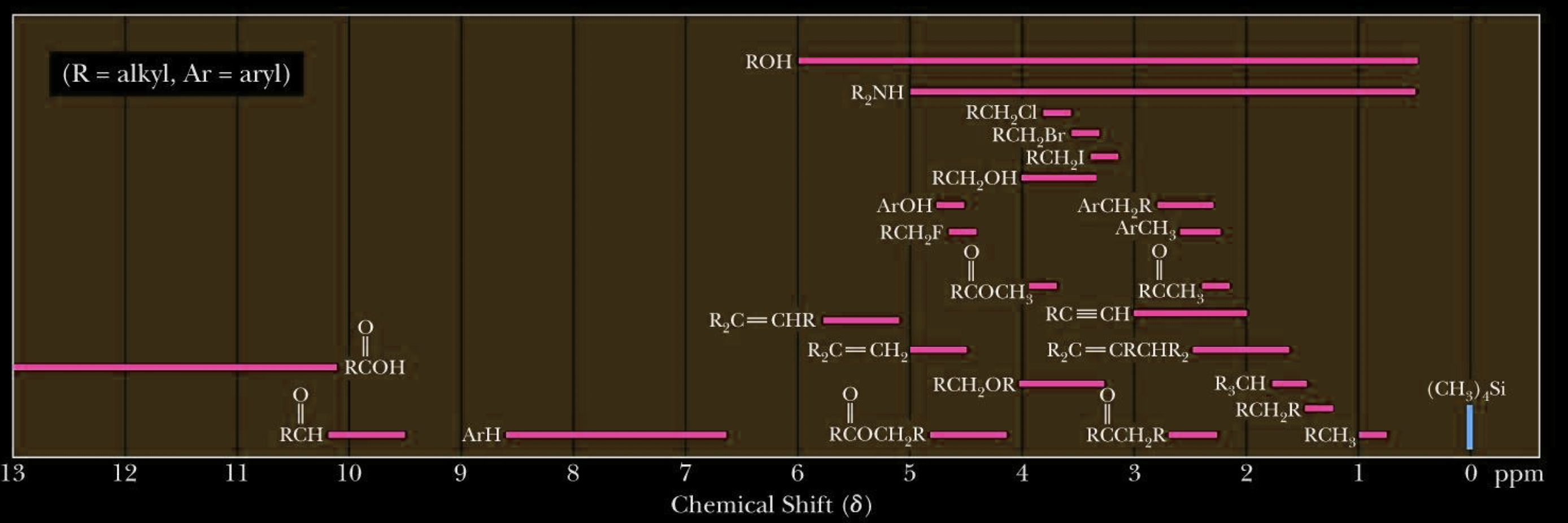
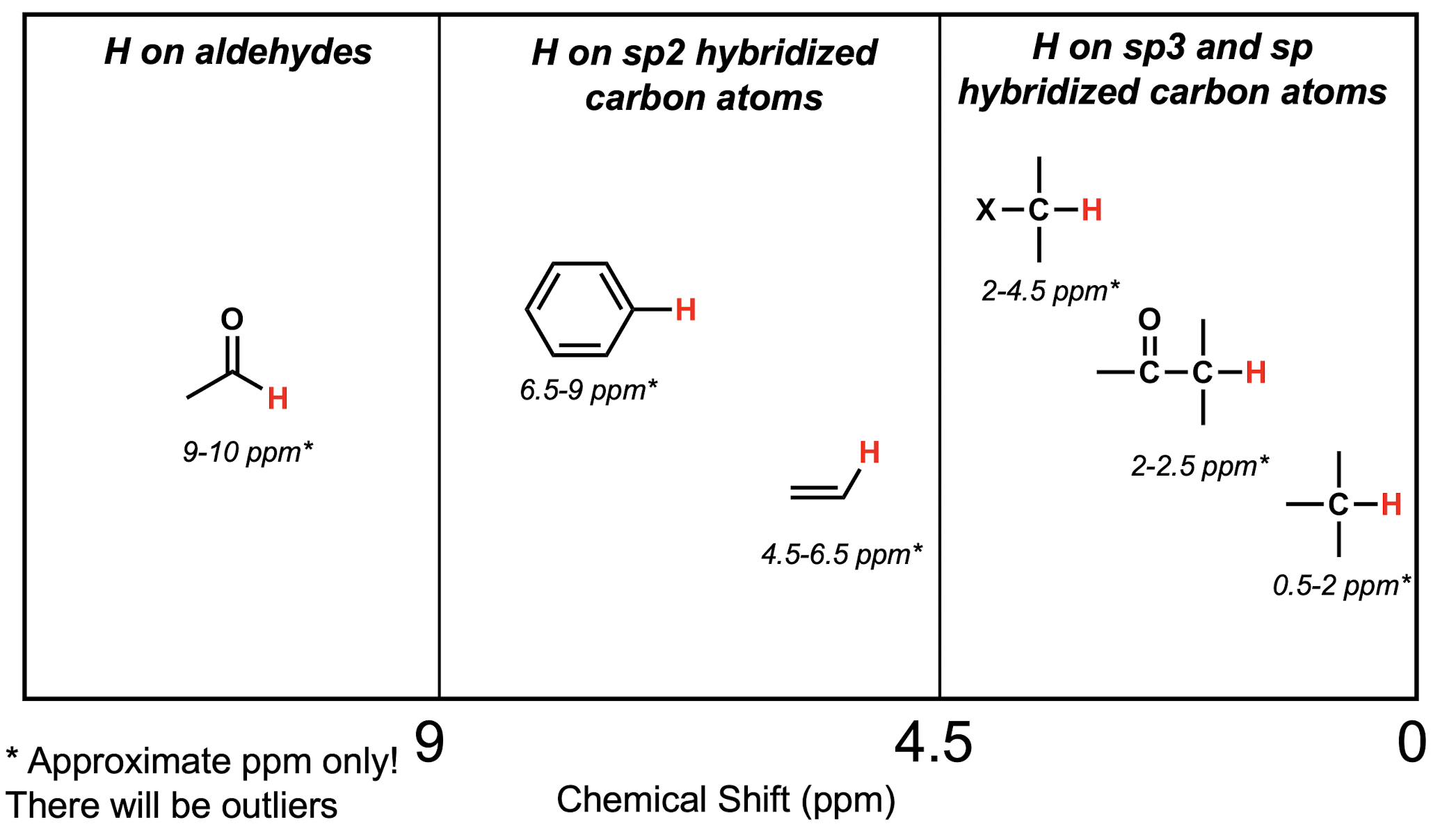
The area under the curve for a signal corresponds proportionally to the number of hydrogens that emit that signal
Peaks vs Signals
Each group of equivalent hydrogens produce exactly one signal
These signals can be composed of 1, 2, 3, 4, or multiple peaks. We then may say a signal is split into/has a multiplicity of a singlet, doublet, triplet, quartet, or multiplet
Chemical Shifting
A greater chemical shift in NMR means a lower $\displaystyle \nu$ relative to that of TMS
Downfield (deshielded or more polar) molecules have greater chemical shift
Upfield (shielded or more nonpolar) molecules have less chemical shift
Signal Splitting
$\displaystyle (n+1)$ rule
$\displaystyle \ce{^{1}H}$ NMR signal is split into $\displaystyle n+1$ peaks, where $\displaystyle n$ is the number of non-equivalent hydrogen neighbors
Only applicable if the hydrogen neighbors are the same or similar in coupling to each other
Coupling Constant $\displaystyle (J)$
Describes the separation between two peaks in a signal