Dirac Delta
#Physics
Universal Danker Video
Topics
Definition
- $\displaystyle \int_{-\infty}^{\infty} \delta(x) , \mathrm{d}x=1$
- $$
\delta(x)=
\begin{cases}
0, & x\neq 0 \\ \infty & x=0
\end{cases}
$$
$\displaystyle \delta(t)=\lim_{ \Delta \to 0 }\text{rect}_{\Delta}(t)$
- $\displaystyle \text{rect}(t)$ is the unit rectangle
Properties
$\displaystyle \int_{-\infty}^{\infty}f(x)\delta(x) , \mathrm{d}x=\int_{-\infty}^{\infty}f(x)\delta(-x) , \mathrm{d}x=f(0)$
- The delta function is symmetric and has the effect of sending an integral of $\displaystyle f(x)$ to $\displaystyle f(0)$
$\displaystyle \int_{a}^{b} f(x)\delta(x-x_{0}) , \mathrm{d}x=0 \text{ for } x_{0} \notin [a,b]$
- The delta function in an integral evaluates to 0 if $\displaystyle x_{0}$ is not in the bounds of integration
$\displaystyle \int_{-\infty}^{\infty} f(x)\delta(x-x_{0}) , \mathrm{d}x=f(x_{0})$
$\displaystyle \int_{-\infty}^{\infty} f(x)\delta(k x) , \mathrm{d}x=\frac{1}{\lvert k\rvert}f(0)$
- This is shown by a u-substitution of $\displaystyle u=kx$
- The absolute value sign occurs because the delta function is symmetric because $\displaystyle \delta(x)=\delta(-x)$
$\displaystyle \delta(x-x_{0})=\frac{1}{2\pi}\int_{-\infty}^{\infty} e^{ik(x-x_{0})} , \mathrm{d}k$
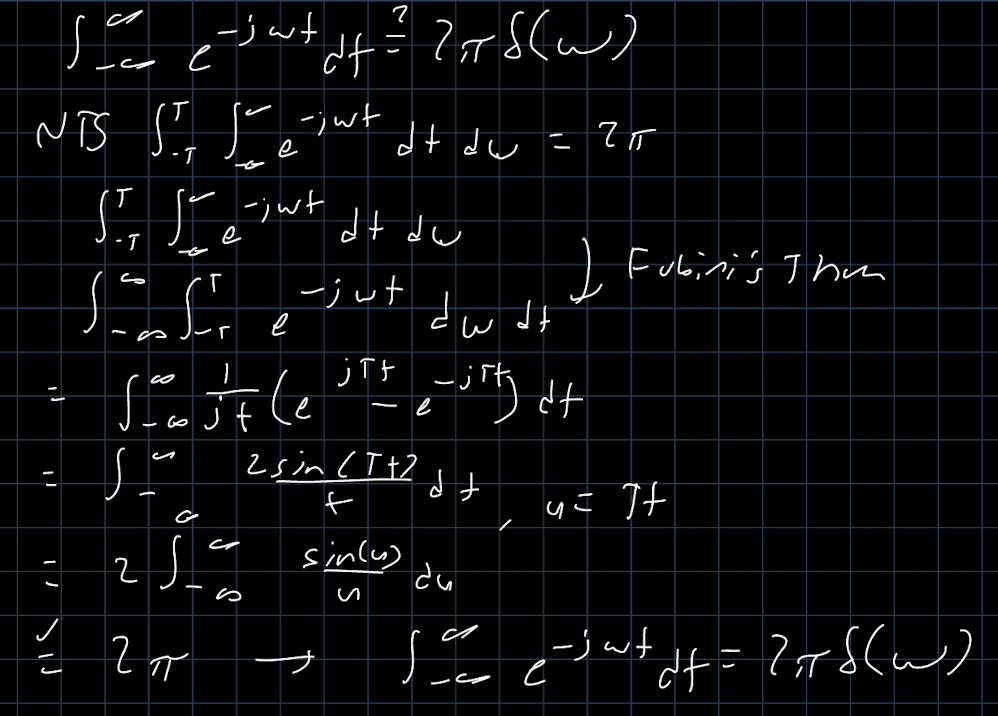
- Another way of saying this is $\displaystyle \mathcal{F}[1]=2\pi \delta(\omega)$, or the Fourier Transform of a constant $\displaystyle a$ is $\displaystyle 2\pi a\delta(\omega)$
- Proof: