Harmonic Functions
#Math
Functions that solve Laplace's equation and also satisfy the mean value property
1D
$\displaystyle \partial_{x}V=0$
$\displaystyle V=mx+b$
- General solution
2D
Has no local extrema. Intuitively, it's a surface that minimizes surface area while still meeting the boundary conditions much like the line solution in 1D. A ball would also always roll off the edge without finding a spot to rest
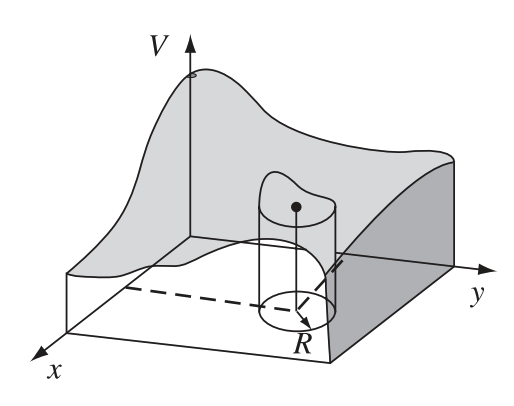
$\displaystyle \partial_{x}V+\partial_{y}V=0$
3D
$\displaystyle V(r,\theta)=\sum_{l = 0}^{\infty}\left( A_{l}r^{l}+\frac{B_{l}}{r^{l+1}} \right)P_{l}(\cos \theta)$
- General solution to Laplace's equation in spherical coordinates
- $\displaystyle P_{l}$ is the Legendre polynomial
$\displaystyle A_{l}=\frac{1}{2{\varepsilon}{0}R^{l-1}}\int{0}^{\pi} {\sigma}{0}(\theta)P{l}(\cos \theta) \sin \theta, \mathrm{d}\theta$
$\displaystyle V(s,\phi)=a_{0}+b_{0}\ln s+\sum_{k = 1}^{\infty}[s^{k}(a_{k}\cos k\phi+b_{k}\sin k\phi)+s^{-k}(c_{k}\cos k\phi+d_{k}\sin k\phi)]$
- General solution to Laplace's equation in cylindrical coordinates